Garage Door Repair & Replacement in Commerce City, CO
Commerce City's housing dates mostly from 2004, newer than most of the Arvada service area. Here's what that means for the doors, springs, and repairs on your street.
Most houses in Commerce City went up around 2004, which puts the doors here a good 25-30 years newer than what we see closer to Arvada. That means steel sectional doors in the wider builder-standard sizes - 16-foot doubles more often than the narrower singles you find on older streets - with factory insulation and torsion springs sized for that heavier panel weight. The openers tend to be chain or belt drive from the early-to-mid 2000s, not the older screw-drive units common in 1960s and 70s neighborhoods.
Because the stock here skews newer and more uniform, we carry torsion springs in the common builder-grade wind and cable lengths that match 2000s-era double doors, along with standard steel rollers and the plastic idler pulleys those openers use. What we don't keep on the truck is anything custom - a non-standard panel color, a specialty insulated glass insert, or an odd-width single door from an older remodel. Those get ordered, and that adds a day or two before we're back out.
How Long You Are Without the Door
We run out of Arvada, and Commerce City sits about 19 miles from there, so there's no depot around the corner and we don't promise a same-day window just because the part is common. What we can tell you is that the door stock here is consistent enough - mostly one era, mostly the same handful of spring and cable sizes - that if your fault matches what's typical for a 2004-built house, the part is usually already on the truck and the visit itself doesn't run long.
Where it stretches is if you've got a custom door or an opener that's been swapped out for something newer than the house. In that case we're ordering before we can finish the job, and the drive adds to the gap rather than shrinking it. If you want a sense of what we cover on this side of town before you call, the service area overview and the main Arvada garage door service page both cover it.
The Symptom
On a door built around 2004, the failure we see most is a torsion spring that's simply worn out - not snapped from age like an original 1970s spring, but fatigued from cycle count. A double garage door in a household that uses the car daily runs through thousands of open-close cycles a year, and the standard builder-grade spring on these newer doors just wears through its rated life faster than the heavier-gauge springs older, smaller single doors used to get.
You'll notice it as the door starting to feel heavier by hand, the opener straining or reversing partway up, or a spring that's visibly stretched with gaps between the coils. Cable fraying near the bottom bracket is the second most common call, usually on the same double doors, since the added weight puts more load on the cable run than a single-door setup ever sees.
What Causes It Around Here
This area sits in the same severe cold climate band as the rest of the region, and that matters more for a 2000s-era door than people expect. The galvanized coating on a standard builder-grade spring is thinner than what went into older, heavier-duty hardware, and repeated freeze-thaw cycling makes that coating crack faster, which lets the steel underneath corrode and fatigue sooner than the spring's rated cycle count would suggest.
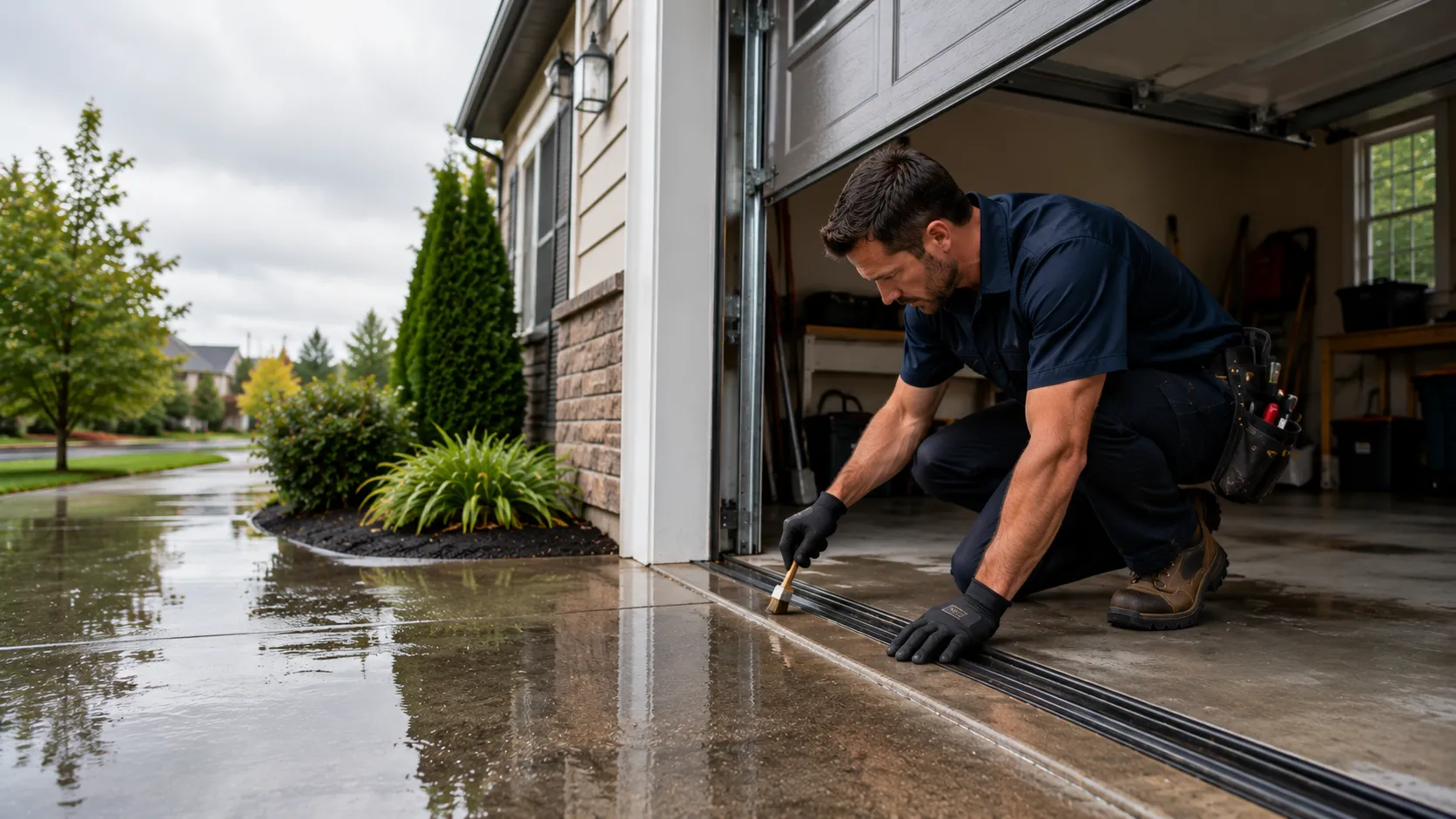
The other factor is size. A wider double door has more surface for cold air to work against, and the bottom seal on a 2004-built house - original to the door, in most cases, since these houses haven't hit a full replacement cycle yet - tends to be the first thing to harden and crack in a hard winter. Once that seal goes, moisture gets under the bottom panel and speeds up rust on the bottom bracket and roller. We don't reseal a door as a standalone fix if the bracket underneath is already rusted through; at that point it's cheaper to swap the section than to keep patching around it.
How it works
From “it’s stuck” to “it’s fixed”
01
Tell us what’s wrong
Describe the symptom - won’t open, loud bang, opener runs but the door won’t move.
02
On-site diagnosis
A technician tests the door under power and by hand and finds what actually failed.
03
Clear, up-front plan
You get the fix that’s needed and what drives the cost - before any work starts.
04
Repaired & tested
The repair is done, the door is set true and tested, and the work area left clean.
Serving Arvada, CO - tell us what your door’s doing and we’ll take it from there.
Straight answers about garage door repair in Arvada. Still unsure? Ask us directly.
Are the doors in Commerce City different from what you see in Arvada itself?
Yes. Most Commerce City houses date to around 2004, decades newer than the mixed 1938-2010 stock closer to Arvada. That means wider steel sectional doors, standard torsion springs sized for double-door weight, and chain or belt-drive openers rather than the older screw-drive units you find on 1960s and 70s streets.
Do you have a branch in Commerce City?
No. We run out of Arvada, about 19 miles away, and travel out for the job. That doesn't change what's on the truck - the parts common to 2000s-era doors are stocked either way - but it does mean we schedule the visit rather than dropping by on short notice.
Why did my spring fail if the house isn't that old?
Builder-grade springs on newer double doors are rated for a set number of cycles, and daily use adds up fast. Add the severe cold swings this area gets, which crack the spring's coating and speed up corrosion, and a spring on a 2004-built door can wear out well before the house itself shows any age.
Is it worth resealing the bottom of the door instead of replacing the panel?
Only if the bracket underneath is still sound. Once the bottom seal has hardened and cracked and moisture has gotten under the panel long enough to rust the bracket, a reseal alone doesn't hold. We'll tell you straight if a panel swap is the cheaper fix over the long run.